Your Uber won't stop for soba
04/25/2026 - Tokyo, Japan
After a minute or so at the intersection, I saw a big cluster of cars coming my way. I stretched out my hand, signaling for salvation. No luck. Another wave of cars, still nothing. Figuring it must be the side of the street I was on, I crossed to try my luck in the other direction. Sure enough, right as I got to the other side, a few taxis zoomed by going the opposite way. Damn it, I grumbled. It was almost midnight and I was getting nervous that a ride would be harder and harder to find.
Finally - a taxi saw my helpless hand, turned on its hazards, and careened toward me. The door opened and I jumped in.
Konbanwa, I said, one of the five words of Japanese I could offer. I pulled up the address of my hotel on Google Maps and slid the phone beneath the plastic divider. He turned on the cabin lights, studied my phone, and punched the address into his own GPS. Okay, okay, he nodded, handed the phone back, turned off the lights, and started the meter.
Tired from a long day of walking, I sank into my seat and gazed out the window. It was my second-to-last night in Tokyo and I started to feel sad watching the city pass by. I always get nostalgic when I’m about to leave a place - a trait I could live without.
“You visit?”
“Uh, yeah,” I looked up to meet my driver’s eyes in the rearview mirror.
“Where from?”
“The United States. Seattle.”
“Ohhhh...Ichiro?”
“Yeah, Ichiro!” I thought about telling him I got Ichiro’s autograph when I was little, but that seemed long winded for a taxi ride.
We were driving through a stretch that still had people crawling about and stumbling out of izakayas. Every few seconds he’d point to something and speak in Japanese. I’d nod along and mutter the occasional ahhhh to feign understanding. He was friendly and relentless with his pointing, the kind of guy who would keep talking to you as if you were fluent.
A few minutes in, I pulled up Google Translate and asked him what his favorite food was.
“Ohhh, hmmm.” He paused, clearly a question he takes seriously. “Soba,” he eventually said.
“Ahh, soba...oishii” - one of the other five words I could muster.
“Oishii?” He looked at me in the rearview mirror.
“Oh yeah, of course...I mean, uh, hai, hai.”
Then he was off again, excitedly pointing and speaking Japanese. This time, after enough stupid grunting from me, he seemed to pick up that I did not in fact understand. We rolled up to a red light and he opened the translate app on his phone.
“Do you have time?” he asked, holding up the screen.
“Uhh, hai,” I replied, confused but going with it anyway.
“Soba,” he said emphatically, pointing to our left. He pulled the car over, pointed at the meter to show me he’d stopped it, looked at me for assurance, then enthusiastically gestured me out of the car.
“Oh, uh, hai,” I nodded.
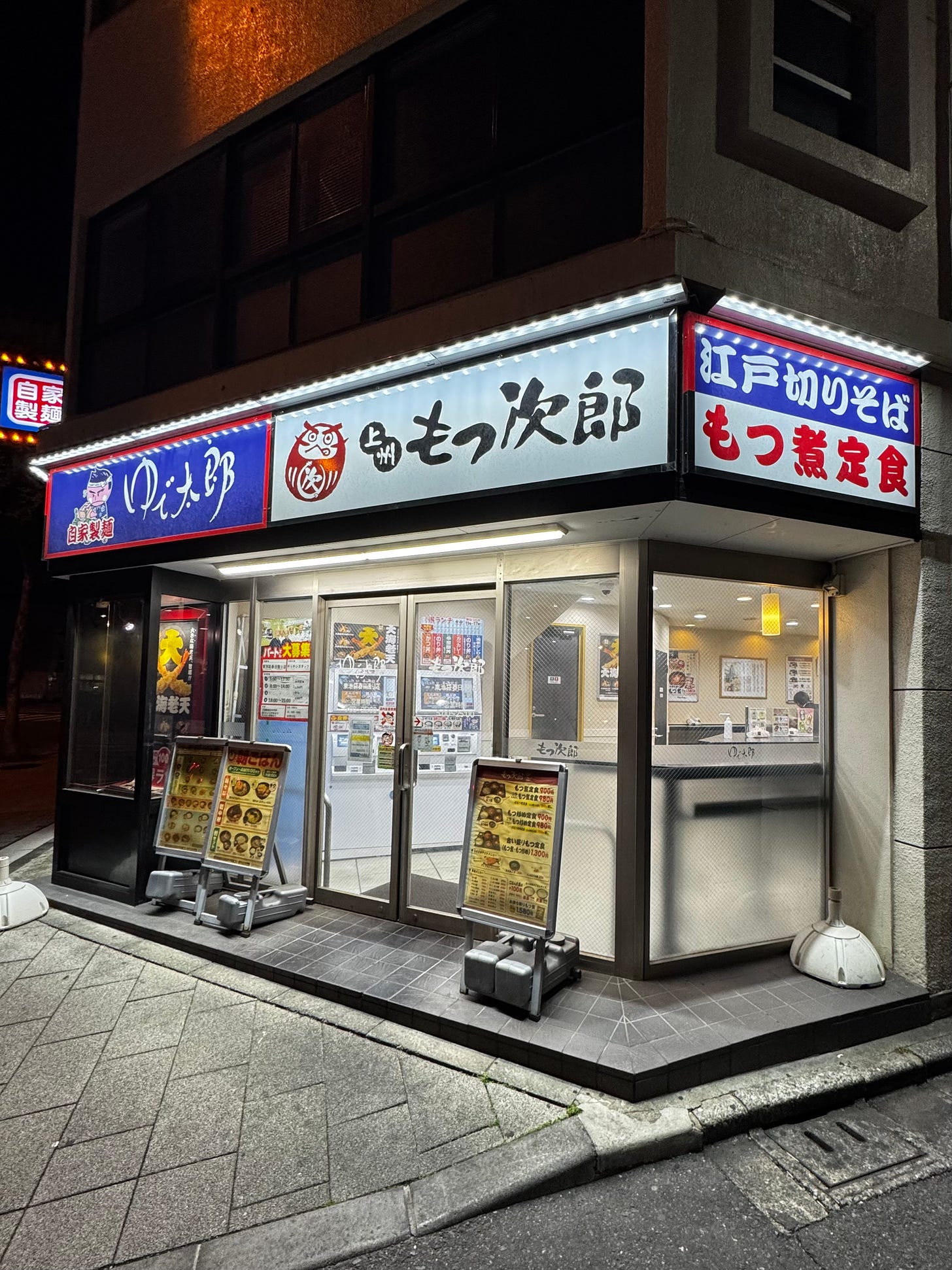
The soba shop was bare bones - a ticket machine to order and one or two people working behind the counter. He took out his wallet and fed 1,000 yen into the machine, looked at me, and pointed. Realizing he wanted me to order, I pulled out some cash and held it out. He waved me off and pointed at the machine again.
I couldn’t quite make out what I was getting, but from the pictures I could tell I had my choice of soba in broth, soba in broth with shrimp tempura, or about twenty other variations of it. I picked the bowl with tempura - it was big and bold on the screen, clearly the featured option. Good choice, I thought to myself as he ordered the same. The machine spit out two tickets, which we handed to the woman behind the counter.
By the time I’d washed my hands, two trays of soba and shrimp tempura were waiting on the counter. He gestured me over to the condiment section and narrated all the options in Japanese. I took a few scoops of the ones he seemed most excited about.
Then we sat down and slurped. Between bites we’d pass our translation apps back and forth. I asked where he was from, how long he’d been in Tokyo.
“What’s your name?” I finally asked.
“Tono,” he said. I typed it out on my phone to confirm the spelling.
More slurps, more questions. I learned that he was from a town in northern Japan that had been lost to an earthquake. That he’d been in Tokyo for twenty years. That he lived near where he’d picked me up and that I was his last fare of the night. And that this happened to be his favorite soba shop - cheap and oishii. More questions, more slurps.
As we were leaving, I gestured at my camera, hoping for a picture.
“Ohhh, hai” - he turned, raised both arms, and gave me a big triumphant flex of the biceps.
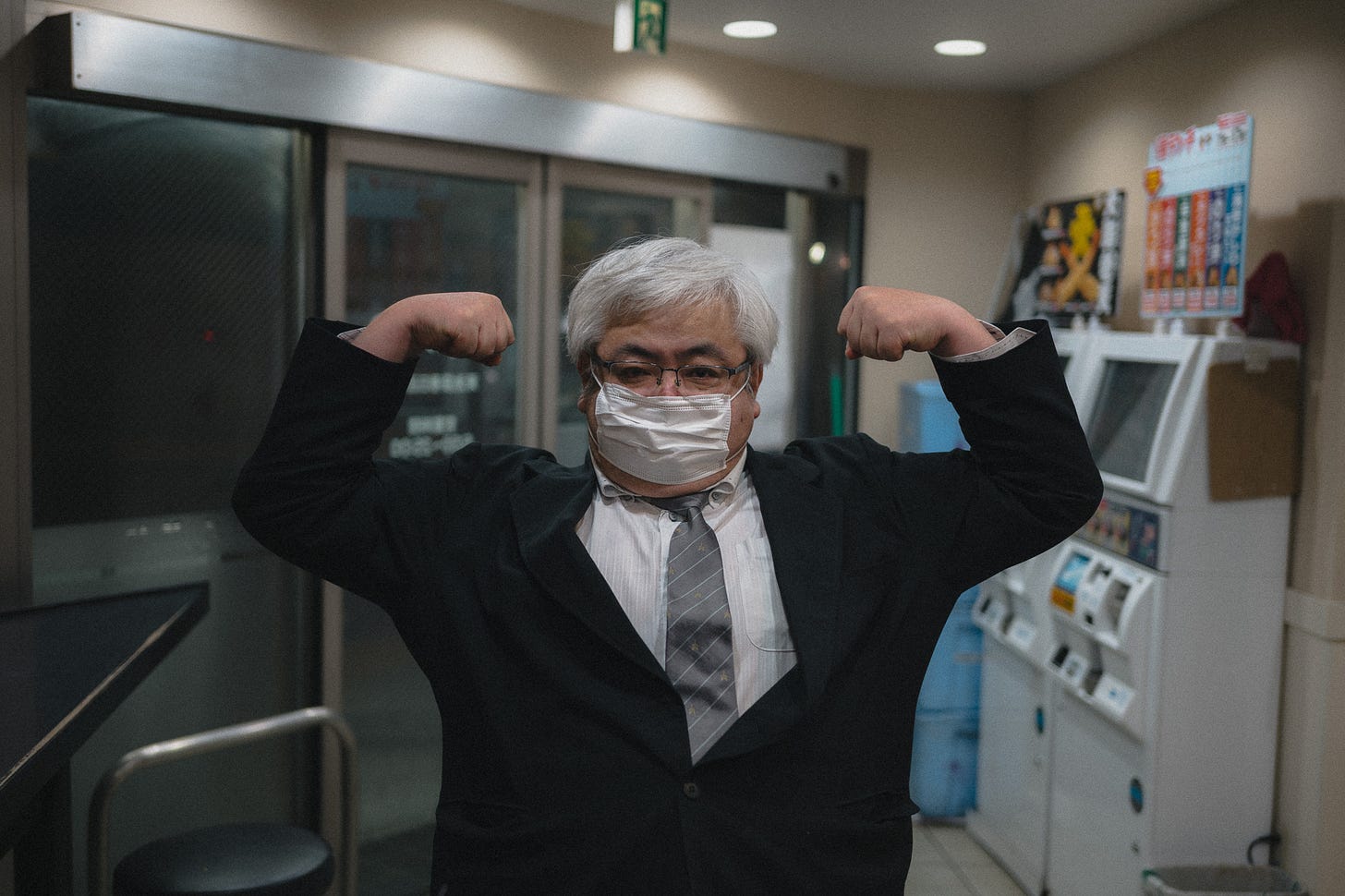
After a few shutter snaps, he glanced outside, pointed at his car and scampered out. I followed and found him already posing next to the taxi.
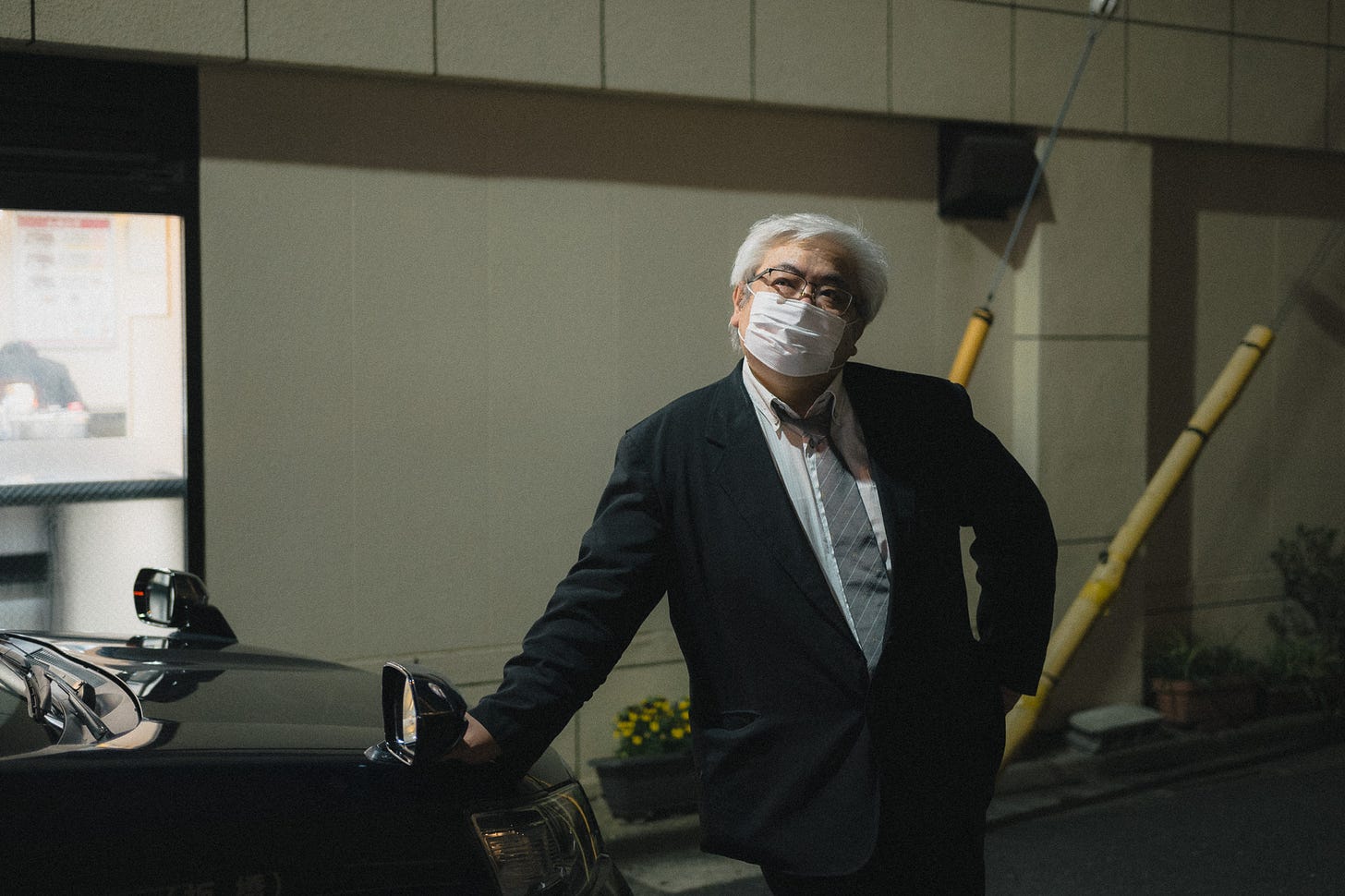
That was it. We climbed back into the taxi, he unpaused the meter, and off we went to my hotel. I thought about it the whole way back.
A few months before Tokyo, I found myself in San Francisco in my first Waymo. It was fine, interesting even - I spent the whole ride watching the steering wheel turn and correct, turn and correct. The driving felt surprisingly natural, actually, from the acceleration to how it crept into intersections to take a free right. Genuine engineering marvel.
But when I asked the friends I was with what they liked about it, nobody led with safety, traffic, sustainability, or any of the typical pitch deck bullet points. The consistent refrain was some version of: “You can pick your music and temperature, nobody tries to talk to you, and it doesn’t smell.”
I didn’t really disagree. But I also can’t remember a taxi’s smell, music, or chatty driver ever costing me much sleep. You’re in the thing for what, twenty minutes?
One of the marvels of Tokyo is the abundant, relatively affordable taxi. Even at midnight in a random neighborhood I was able to flag one down within a couple minutes. For someone my age, that’s a novelty - whatever big-city taxi-hailing days I might have had were swallowed up by the press of a button. But there’s something about hailing a cab that feels...right? Tactile? Intuitive?
I think it’s the power dynamic. When you hail a taxi your arm is out in the air asking for help - you’re powerless, waiting for a stranger in the right place at the right time to answer your call. That reciprocity is important. When you order an Uber, Lyft, whatever, that dynamic inverts completely. You command them to you. The transaction is already underway before a door has even opened - we both see the fare, ratings, conversational preference. The transaction is centered, not the person.
I was thinking about all this on the ride back to my hotel with Tono. My soba noodle fever dream would never have happened in an Uber. Too much rigidity, too frictionless for soba. I’m acutely aware of how technology shapes our travels, and while I’m ready to be anti-technology, I can’t, exactly. Without my smartphone and Google Translate, I might never have tried Tono’s favorite late-night spot. Or learned that his hometown was swallowed by an earthquake. To me the distinction is that one facilitates a human connection, the other supplants it. And somewhere we started optimizing for the latter.
There’s a good chance I’m romanticizing my time with Tono. After all, most taxi rides are just quiet, uneventful rides. But sometimes they’re meaningful. When millions of small human moments are replaced by a couple swipes, how many times are we missing out on a good bowl of soba?
No spam, no sharing to third party. Only you and me.
Member discussion